


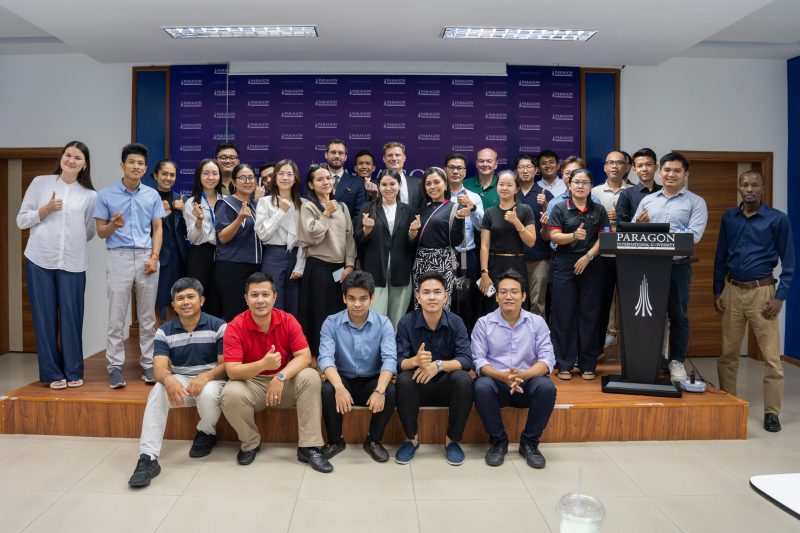
Following a recent DBA Research Seminar, an internationally recognized academic shares candid advice on research design, the doctoral mindset, and why the right question matters more than the right answer.
Interview conducted at Paragon International University, Phnom Penh · DBA Program · May 2025
Doctoral research is not simply about producing more pages, more citations, or more data. It is about asking a question that matters and having the intellectual discipline to follow it through. This was the central message Dr. Robert Casper brought to Paragon International University’s DBA Research Seminar, where doctoral students and faculty gathered to examine one of the most consequential stages of the doctoral journey: the research proposal.
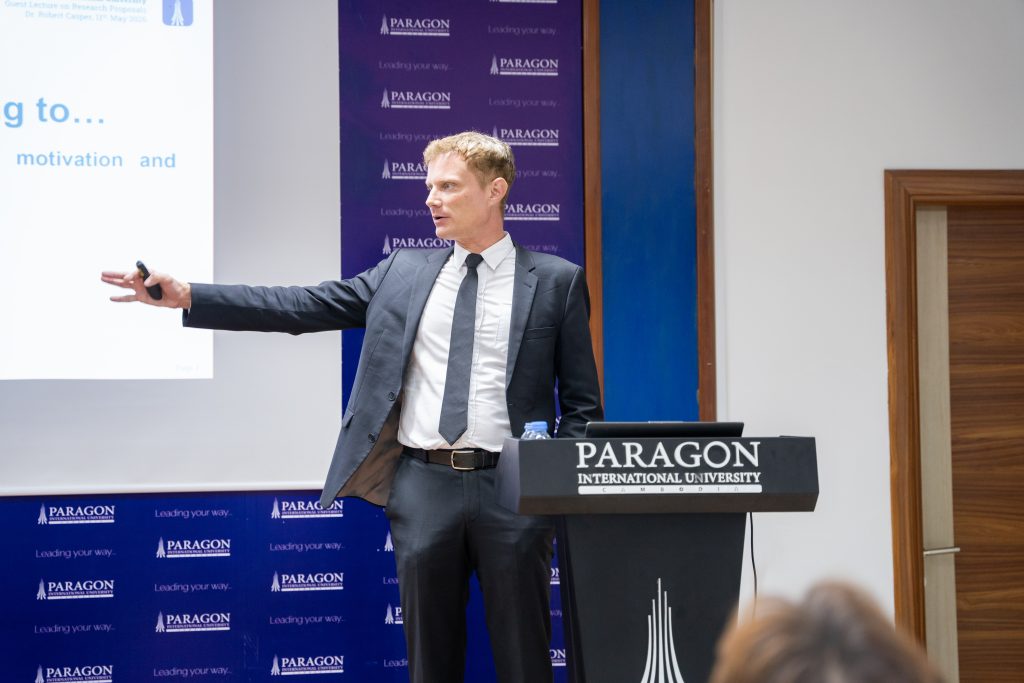
Dr. Casper is a British-German senior university lecturer and research fellow with an international academic profile spanning Europe and Southeast Asia. His doctoral research at Linköping University focused on closed-loop supply chains and EV battery recycling, work that exemplifies precisely the kind of rigorous, real-world inquiry the DBA model aspires to. In the conversation that followed the seminar, he shared his perspective on what distinguishes a strong proposal from a forgettable one, and what DBA students most often get wrong.
1. WHAT IS THE BIGGEST MISCONCEPTION STUDENTS HAVE ABOUT RESEARCH PROPOSALS?
The most common mistake is treating the proposal as a formality something to be submitted rather than something to be thought through. Students often believe that length signals rigor. They add more sections, more literature, more frameworks, hoping that volume will convey seriousness. But a proposal is not a draft thesis. It is an argument: here is my question, here is why it matters, and here is how I intend to answer it. If those three things are not clear in the first few pages, the rest is noise.
2. WHAT MAKES A DBA RESEARCH PROPOSAL STAND OUT?
Clarity and contribution. A proposal that can articulate, in plain language, exactly what it is studying and what it will add to existing knowledge that already puts it ahead of the majority. Beyond that, the best DBA proposals demonstrate relevance without sacrificing rigor. The DBA is a practitioner doctorate. The research question should emerge from a genuine organisational or managerial problem, but the method of inquiry must meet academic standards. When those two things are in balance, the proposal is compelling both to academics and to practitioners.
3. WHAT ARE THE MOST COMMON MISTAKES DOCTORAL STUDENTS MAKE AT THIS STAGE?

Three recur consistently. First, the research question is too broad. Students want to ‘explore leadership in Cambodia’ or ‘examine digital transformation in banking’ but these are topics, not questions. A researchable question is specific, bounded, and answerable. Second, the review of literature becomes a summary exercise rather than a critical engagement. Reading widely is not enough; students need to identify the gap their research addresses. Third, the methodology is chosen for comfort rather than fit. Some students default to surveys because they are familiar. The method must serve the question, not the other way around.
4. HOW IMPORTANT IS THE RESEARCH QUESTION ITSELF?
It is everything. The research question is the architecture of the entire project. A well-defined question determines your literature review, your methodology, your data collection, your analysis, and ultimately the contribution your work can make. I often tell students: if you cannot write your research question in one clear sentence, you do not yet have a research question. You have an interest which is the beginning, not the end. A well-defined question is already half the work done.
“A research proposal is not about writing more pages. It is about asking the right question and defending why that question deserves to be answered.” Dr. Robert Casper
5. WHAT MINDSET SHOULD DBA STUDENTS DEVELOP DURING THEIR DOCTORAL JOURNEY?
Tolerance for ambiguity and intellectual honesty. Doctoral research rarely proceeds as planned. The data surprises you, the framework evolves, an assumption collapses. Students who struggle most are those who feel that deviation from their original plan is failure. In reality, it is the process working as it should. Good researchers follow the evidence, revise their thinking, and remain committed to the question even when the path changes. They also learn to sit with uncertainty to not rush to conclusions before the evidence supports them.
6. BASED ON YOUR INTERNATIONAL ACADEMIC EXPERIENCE, WHAT DIFFERENTIATES STRONG DOCTORAL RESEARCHERS?
Intellectual curiosity that is sustained, not episodic. Strong researchers are not simply diligent they are genuinely interested in what they do not yet understand. They read beyond their immediate topic. They engage with ideas from adjacent fields. They are willing to be wrong and to say so. Across contexts Europe, Southeast Asia, the Middle East this quality appears consistently in researchers who produce work that endures. The institutional context matters less than you might think. What matters is the disposition of the individual toward knowledge itself.
7. HOW CAN DBA RESEARCH REMAIN ACADEMICALLY RIGOROUS WHILE ALSO ADDRESSING REAL BUSINESS PROBLEMS?
This tension is often overstated. Rigor and relevance are not opposites they are complements. A study grounded in a real organisational problem, using appropriate methods, analysed critically and situated within the scholarly literature: that is both rigorous and useful. The mistake is to treat applied research as lesser research. The DBA exists precisely because business and management problems deserve the same quality of inquiry that any other domain receives. The bar is not lower; the audience is different. And when you get it right, the work speaks to both worlds simultaneously.
“If you cannot write your research question in one clear sentence, you do not yet have a research question. You have an interest, which is the beginning, not the end.” Dr. Robert Casper
Paragon International University thanks Dr. Robert Casper for his generous time and expertise. The DBA Research Seminar series is designed to support doctoral candidates at each stage of their research journey, from initial proposal through final defense. Information on upcoming seminars and research events is available through Paragon’s official channels.
ABOUT THE SPEAKER
Dr. Robert Casper (Dr. Bob)
Senior University Lecturer and Research Fellow
Nationality
British-German
Current Affilation
Senior University Lecturer and Research Fellow
Education
Undergraduate degree, Cologne, Germany
PhD in Manufacturing Engineering, Linköping University, Sweden
Doctoral research: Closed-loop supply chains and end-of-life strategies in the automotive industry, with particular emphasis on EV battery recycling and remanufacturing.
Teaching Areas
Supply Chain Management · Operations Management · Research Methodology · Project Management · Strategic Sourcing and Procurement · Circular Economy and Sustainability
Research Interests
Circular production strategies, remanufacturing, closed-loop supply chains, and end-of-life concepts.
International Experience
Visiting scholar and lecturer in Phnom Penh, Cambodia; Hanoi and Ho Chi Minh City (Saigon), Vietnam.
Publications & Conferences
Published in multiple international academic journals. Contributor to numerous international conferences as author, keynote speaker, and panelist.