

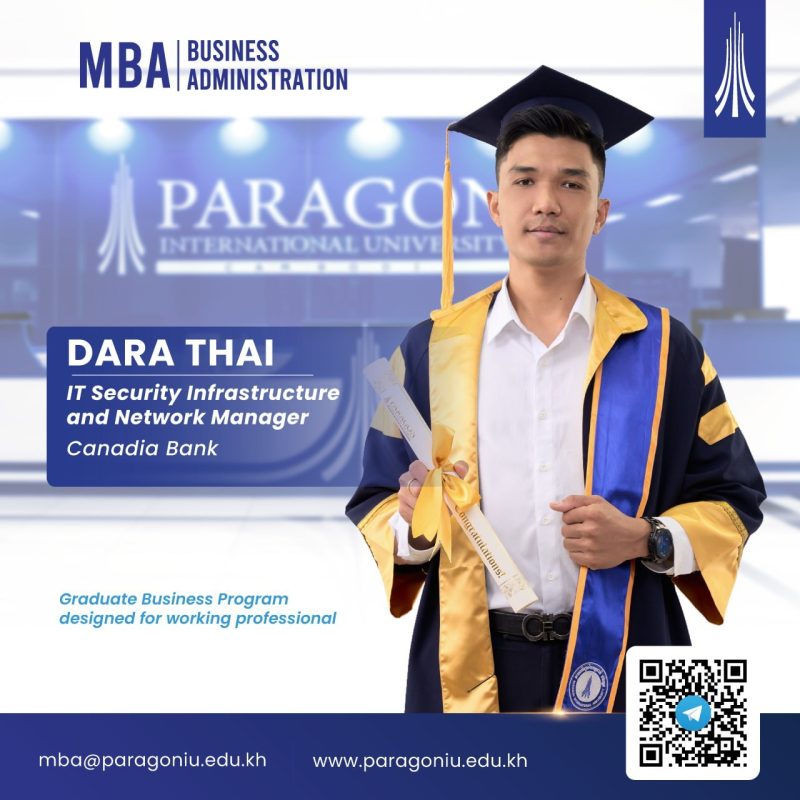
As we continue to highlight the experiences of our MBA students and graduates, we spoke with Dara Thai, an IT Security Manager at Canadia Bank and an experienced cybersecurity professional working at the intersection of technology, risk, and business.
Dara joined Paragon International University’s MBA program to broaden his perspective beyond technical expertise and strengthen his capabilities in strategy, leadership, communication, and decision-making. In this interview, he reflects on how the MBA has helped him connect cybersecurity with broader business objectives, improve the way he communicates with stakeholders, and prepare for greater management responsibilities.
1. What made you choose Paragon.U’s MBA, and what is your role at Canadia Bank?
Pursuing a Master’s degree has always been one of my personal goals. I had hoped to study abroad one day; however, balancing professional responsibilities and family commitments made that difficult.
Paragon International University gave me the opportunity to pursue an internationally oriented MBA program in Cambodia without compromising these responsibilities. I was particularly wanted to study at Paragon International University because the program is designed to accommodate working professionals and offers a good balance between academic learning and professional development. Paragon International University also has a strong reputation for academic quality and is recognized as one of Cambodia’s leading universities. These factors motivated me to pursue my MBA here.
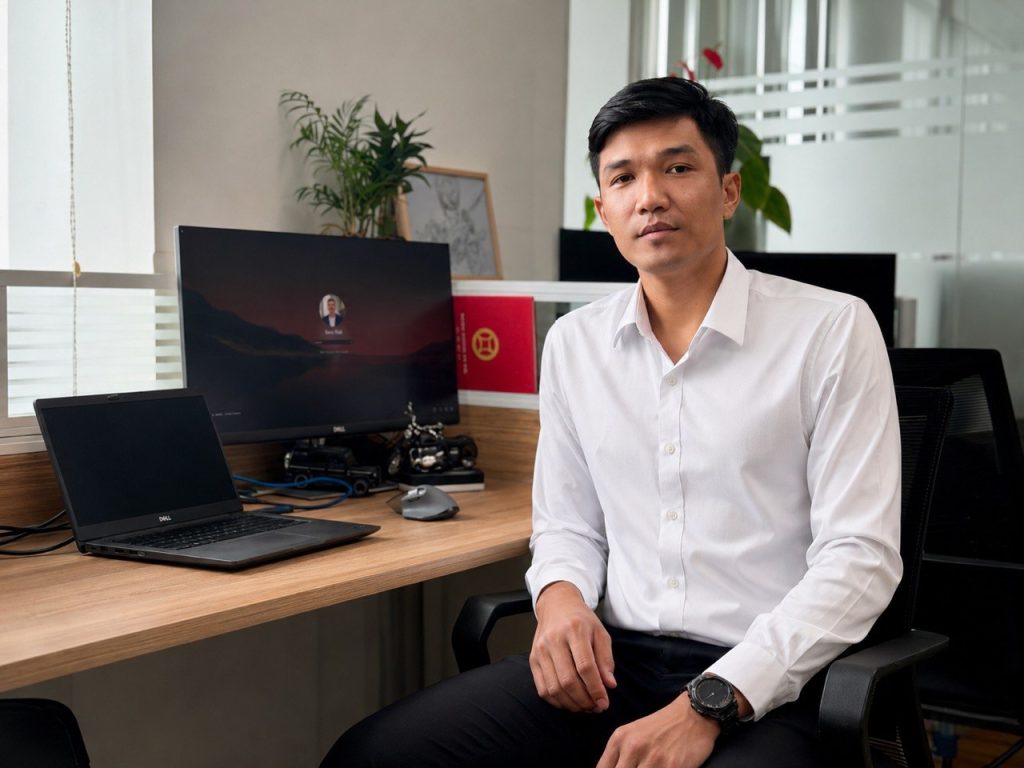
Currently, I work as an IT Security Manager at Canadia Bank, where my responsibilities include managing cybersecurity infrastructure, security monitoring and response, strengthening security controls, maintaining and improving security technologies, and supporting compliance with relevant standards and regulatory requirements.
These include frameworks and requirements such as CIS, NIST, PCI-DSS, and regulations from the National Bank of Cambodia.
My role mainly focuses on the technical and technological aspects of cybersecurity, ensuring that the bank’s digital assets and information are protected through effective security controls, monitoring and response mechanisms, industry standards, and regulatory compliance.
2. Banking is a competitive and fast-evolving industry. Has the MBA changed how you approach your work or decisions at the bank?
Absolutely. I believe technical expertise alone is not enough for long-term career development, particularly when moving toward senior management roles in IT security.
The MBA has broadened my understanding of how technology can be aligned with broader business objectives.
Some of the most valuable lessons I have gained came from subjects such as Operations and Supply Chain Management, Strategic Management, Evidence-Based Management, Professional Communication, and Financial Statement Analysis.
These courses helped me better understand business strategy, operational efficiency, financial considerations, data-driven decision-making, and, most importantly, how to connect technical solutions with business needs.
I also appreciated the way the program encouraged students to conduct research and analysis through project reports and the MBA project. Each project required us to research a problem, analyze evidence, develop practical recommendations, and present our findings.
This approach helped me strengthen my analytical and presentation skills while increasing my confidence in communicating ideas and proposing solutions.
Overall, the MBA has helped me develop my capabilities in strategy, leadership, analysis, decision-making, and communication. As an IT security professional, one of the most important skills I have developed is the ability to translate complex technical issues into business language.
I believe this skill will be particularly important as I continue moving toward more senior management responsibilities.
3. What is one moment from the MBA program that directly applied to your role at Canadia Bank?
One of the most impactful parts of my MBA journey was studying Strategic Management and Professional Communication.
During my first semester, these courses taught me much more than academic concepts. They helped me understand how to communicate more effectively with clients, colleagues, and senior management, including how to prepare professional reports and communicate clearly through emails and presentations.
Among the subjects I studied, Strategic Management was one of the courses I enjoyed the most. I remember working on a strategic analysis project involving a company in Cambodia. The project gave me practical experience in strategy and planning.
We first gathered relevant information and identified reliable sources to analyze the business. We then developed our analysis and presented our findings in a final report.
Coming from a technical background, I initially did not fully understand why business strategy was so important. After completing the project, however, I realized that every organization needs a clear strategy, not only at the organizational level but also at the team level.
We need to understand the current situation, identify strengths, weaknesses, opportunities, and threats, and then develop appropriate solutions to achieve our objectives.
Another valuable experience was working on a project titled “Challenges in Communication and Task Execution.” This project helped me better understand the importance of effective communication.
In addition, Operations and Supply Chain Management taught me how to evaluate processes and optimize resources while reducing unnecessary waste.
After learning these concepts, I was able to apply them directly within my team. I became more confident in designing and improving processes and in making decisions based not only on technical requirements but also on risk prioritization, resource allocation, stakeholder communication, and business value.
The MBA has helped me move beyond a purely technical mindset. It has helped me better understand how IT security and cybersecurity initiatives can support business objectives, improve team performance, and strengthen collaboration with other departments.
This broader perspective has been one of the most valuable outcomes of my MBA journey.
4. How did you balance the demands of working in banking with the MBA workload?
As an IT Security Manager, balancing a demanding professional role with MBA studies required strong time management, discipline, and prioritization.
I learned to prioritize tasks based on their importance and impact rather than trying to do everything at once.
For me, good planning was essential. Whether it involved family, work, or academic commitments, I found that without a clear plan, it was difficult to manage my time effectively.
I therefore set clear schedules and allocated time for each responsibility, whether the task was small or significant.
It was also important to have support from my family and colleagues. Their understanding and encouragement helped me remain productive while maintaining a healthy balance between my professional, academic, and family responsibilities.
This experience also strengthened my ability to prioritize, make timely decisions, and remain focused under pressure, which I believe are important skills for effective leadership.