


1. What surprised you most during your first year?
The biggest surprise was that my research completely changed the business I was planning to start.
When I joined the DBA program, I was planning to start a physiotherapy service for companies. I wanted to provide services such as stretching, massage, and exercise to employees. To explain why employee health matters to companies, I decided to study how health problems are related to productivity.
My DBA research focuses on office-based employees in Phnom Penh. I plan to examine how five common health problems—pain, fatigue, eye strain, stress, and sleep problems—are associated with employees’ work ability and productivity.
As I continued my research at Paragon, I realized I was starting with a solution before understanding the problem. I began to think that using data to identify employees’ health problems and help companies decide what to improve first could be more valuable than offering physiotherapy alone. This completely changed my thinking.
2. What does your new business idea look like?
Now, I am planning a service that collects and analyzes data on employees’ health, workload, supervisor support, and work environment. Every company faces different challenges. In one company, the main problem might be back pain. In another, it might be poor sleep or stress. In some companies, workload or management issues might be more important than employees’ health problems.
The service will also compare results across departments. The goal is to help managers identify key problems, understand how they are associated with work performance, and decide which areas to improve first.
3. How has your daily life changed since joining the DBA program?
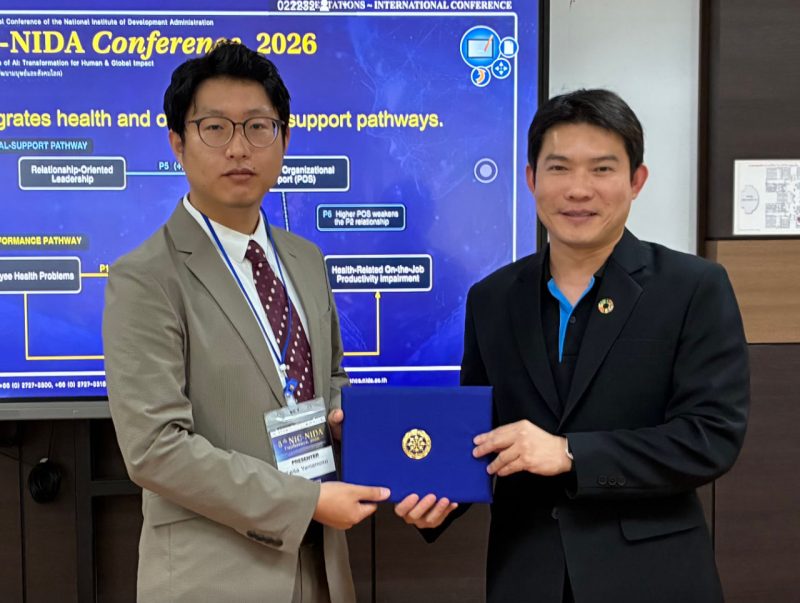
I think the biggest change is that I spend much more time thinking deeply about my research. Over the past year, I’ve worked on my research proposal, read academic papers, discussed my ideas with my supervisor, and presented at an international conference.
Through these activities, I repeatedly ask myself questions such as, “What exactly do I want to find out?” and “Why is this research important for companies?” For me, one of the greatest values of the DBA program is being in an environment where I can continuously think about my research, question my ideas, and turn them into something practical.
4. How does it feel to be a student again?
It’s fun, but of course, it’s also challenging. I’m the Deputy Country Representative of an international NGO. I work from 8 AM to 5 PM and then attend classes. Before exams, I have to study really hard. Sometimes I think, “I’m already in my 30s. Why am I studying for exams again?” But at the same time, it reminds me of my university days.
My classmates have important responsibilities in their companies and organizations. But once we’re in class, we are all students. We worry about exams, discuss difficult subjects, study together, and share the relief when the exams are finally over. I think it is difficult to build this kind of bond through work alone. When I joined the DBA program, I was mainly focused on research and business. But I’ve also come to value the friendships I’ve built with my classmates.

5. What is it like balancing work, DBA studies, and family life?
Am I really balancing everything? I’m not sure. Actually, it’s quite challenging. I wish I could say that I manage my time well, but the reality is not that simple. If I want to spend one hour studying, I have to take that hour from something else, such as personal time, sleep, or time with my family. That choice is especially difficult because I have a three-year-old daughter. I want to make progress with my research, but I also know that I can never get back the time I could spend with my wife and daughter. So, I am still trying to find a good balance.
6. What are you looking forward to most in your second year?
I am really looking forward to starting my data collection. During the past year, I spent a lot of time preparing my research proposal. After my proposal defense, expected in November 2026, I plan to meet with people from companies, explain the importance of my research, and ask for their cooperation. After receiving the necessary ethics approval, I hope to begin collecting data. I am especially excited to collect both quantitative data through surveys and qualitative data through interviews with company managers and employees.
7. If we interview you again in one year, what would you like to talk about?
By this time next year, I hope to complete data collection and share my findings. I also want to explore how companies can use these findings. Separately from my academic research, I hope to pilot my new business idea with interested companies.
Finally, I am looking for companies interested in learning more about my DBA research and open to supporting the survey. If you are interested, please contact me via Telegram at (+855 78 427 300).