



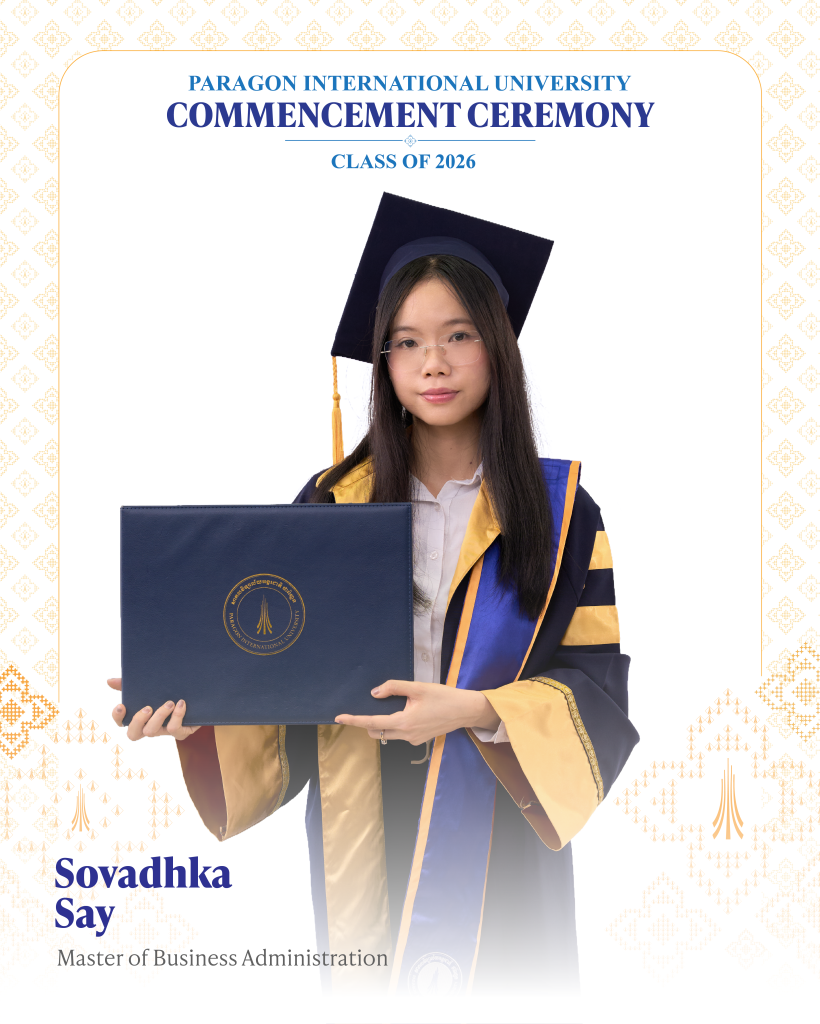
As the semester comes to an end, we are proud to celebrate the achievements of our graduating MBA students. Sovadhka Say, one of our successful graduates, recently shared her experience at Paragon International University and reflected on how the MBA has influenced her professional development and her work at Aplus Consulting.
In this short interview, Sovadhka discusses why she chose MBA, how the program changed her approach to client challenges, the value of her MBA Project, and how she balanced postgraduate study with a demanding professional role.
1. What made you choose MBA, and what is your role at Aplus Consulting?
I chose Paragon.U’s MBA because I wanted to broaden my perspective beyond the technical aspects of finance and tax and develop a deeper understanding of business as a whole. While professional experience helps us build technical expertise, the MBA showed me how finance connects with strategy, operations, marketing, leadership, and organizational decision-making.
Paragon.U’s curriculum matched these goals while allowing me to continue working and apply what I learned directly in practice.
At Aplus Consulting, I serve as Assistant Manager, Finance and Tax. I oversee the company’s internal financial operations, manage clients’ accounting records and financial workbooks, and provide financial and tax consulting services. Working with businesses across different industries has taught me that effective financial advice goes beyond numbers. It requires a clear understanding of each client’s broader business objectives. The MBA has strengthened this perspective and helped me provide more comprehensive and strategic solutions.
2. In consulting, you are constantly advising different clients. Has the MBA changed how you approach client problems or advice?
The MBA significantly changed the way I approach client challenges and provide professional advice. While technical knowledge remains essential, the program encouraged me to look beyond compliance and transactional solutions and consider the broader business context in which each organization operates.
Rather than focusing only on regulatory requirements, I now evaluate how my recommendations align with a client’s strategic direction, operational priorities, and long-term objectives.
The program also strengthened my evidence-based and analytical approach to decision-making. Through research, case studies, and practical discussions, I learned to consider different perspectives before making recommendations. This has given me greater confidence in providing advice that is technically sound, commercially practical, and aligned with each client’s business reality.
3. What is one moment from the program that directly helped you in your work at Aplus?
One of the most meaningful parts of the program was completing my MBA Project. My research explored how businesses in Phnom Penh perceive the role and value of accountants, which gave me a deeper understanding of the expectations and challenges facing professionals in my field.
The project strengthened my research, analytical, and critical-thinking skills, but it also changed how I approach my work. It encouraged me to look beyond immediate financial and tax issues and consider how accountants can contribute more strategically to an organization.
The findings helped me identify both the strengths and the gaps in how accounting professionals are understood and utilized by businesses. This has influenced the way I advise clients and support my team, with greater attention to the long-term value that finance professionals can bring.
I also hope the research contributes to a broader discussion about the evolving role of accountants in Cambodia and provides a useful foundation for future studies.
4. Consulting means juggling multiple clients and deadlines—how did you balance that with the MBA?
Pursuing an MBA while working full time was not easy, but I reminded myself that new challenges often create new opportunities. I was determined to complete what I had started.
To manage both responsibilities, I relied on careful planning, clear priorities, and a structured routine. Rather than waiting for large blocks of free time, I worked progressively and made use of smaller periods throughout the day. This helped me maintain steady progress without compromising the quality of either my professional or academic work.
There were times when client responsibilities and academic deadlines overlapped, so I had to remain adaptable and focused under pressure. Over time, I became more intentional about organizing my workload, managing my energy, and communicating effectively.
The experience taught me much more than academic knowledge. It strengthened my accountability, perseverance, and self-management, while helping me approach demanding situations with greater confidence and discipline.