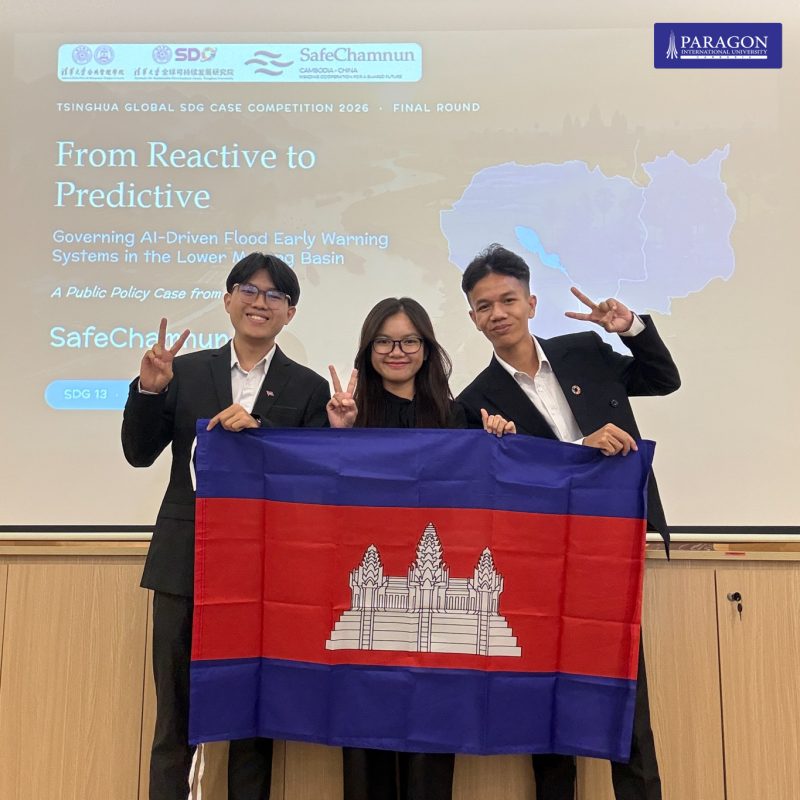
A Cambodian youth research team earns international recognition for its public policy case study, “From Reactive to Predictive: Governing AI-Driven Flood Early Warning Systems in the Lower Mekong Basin — A Public Policy Case from Cambodia.”
Cambodia’s SafeChamnun team has achieved a significant milestone on the international stage, securing 10th place among 325 participating teams and receiving the prestigious Excellent Award at the Tsinghua Global SDG Case Competition 2026, organized by Tsinghua University in Beijing, China.
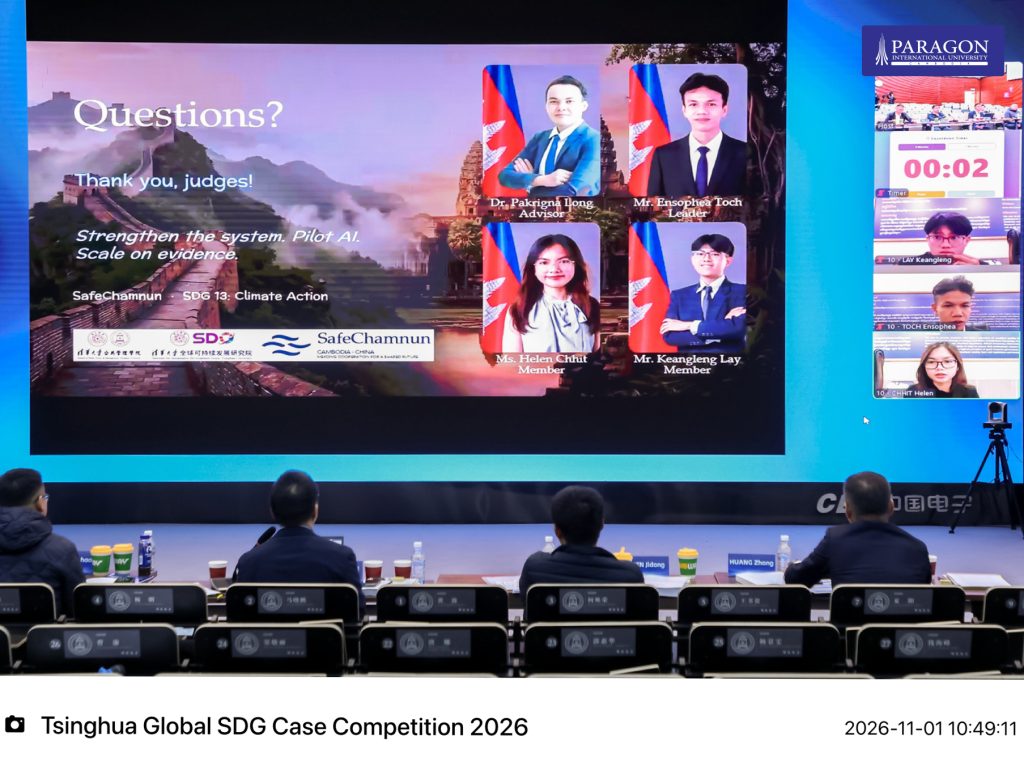
The annual international competition, which began in June 2026, attracted 325 teams representing 251 universities across 45 countries and regions, including China, Vietnam, Australia, the United States, the United Kingdom, Singapore, Canada, Indonesia, India, Japan, Pakistan, Nigeria, and many others.
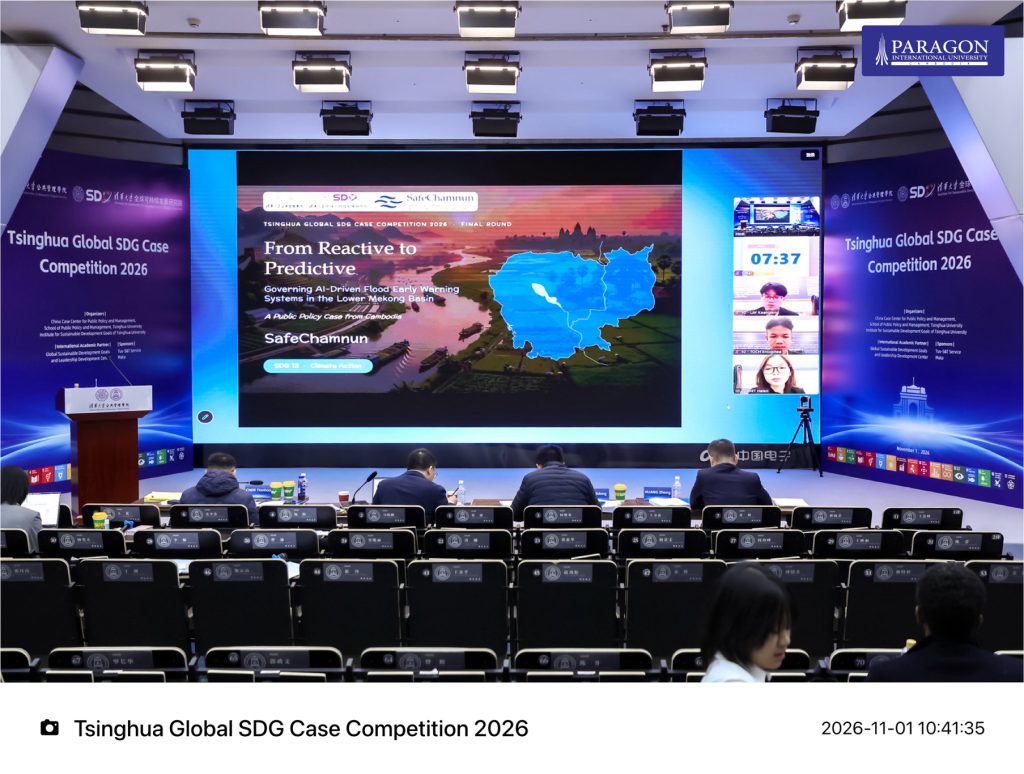
After progressing through multiple competitive stages, SafeChamnun advanced to the final round, held on November 1, 2026, at Tsinghua University in Beijing. The Cambodian team ultimately secured 10th place and received the Excellent Award in recognition of its outstanding case analysis and proposed solutions to challenges related to sustainable development. This achievement highlights the capabilities of Cambodian researchers and young professionals to compete internationally, analyze complex public policy challenges, and propose innovative approaches that connect emerging technologies with real-world societal needs.
The SafeChamnun Team and Its Members
SafeChamnun is a collaborative initiative bringing together Cambodian researchers, students, and professionals from academic institutions and the private sector. The team shares a common commitment to exploring responsible and practical solutions to societal challenges through technology, research, and public policy.
The team consists of:
- Dr. Pakrigna Long — Team Supervisor and Lecturer at the Institute of Technology of Cambodia (ITC).
- Mr. Ensophea Toch — Team Leader of SafeChamnun, student at Paragon International University, and Lead Data Scientist at ECI Distribution.
- Ms. Helen Chhit — Team Member, student at ACLEDA University of Business, and Design Specialist at TWD.
- Mr. Keangleng Lay — Team Member, student at ACLEDA University of Business, and Content Creator.
The team’s success demonstrates the importance of collaboration among researchers, students, and technology professionals in applying knowledge and expertise to address challenges affecting Cambodia and the wider region.
From Cambodia’s Flood Challenges to International Recognition
The award-winning case study is titled:
“From Reactive to Predictive: Governing AI-Driven Flood Early Warning Systems in the Lower Mekong Basin — A Public Policy Case from Cambodia.”
The research examines flooding, one of Cambodia’s major environmental and development challenges, particularly for communities living within the Mekong River Basin.
The study draws on the severe flooding events of October 2020 as a key case context to examine challenges related to flood forecasting, institutional coordination, and the communication of early warnings to vulnerable communities. The SafeChamnun team explored how Artificial Intelligence (AI) could complement Cambodia’s existing flood forecasting and early warning systems, including those operated by the Mekong River Commission (MRC) and the national EWS1294 early warning system.
The project also examined the potential of Google Flood Hub, an AI-powered flood forecasting platform, focusing on how emerging forecasting technologies could be validated and responsibly integrated into existing institutional decision-making processes.
Rather than proposing the replacement of existing national systems, the study emphasizes strengthening them through additional predictive capabilities, appropriate governance, and human oversight.
Responsible AI Governance for Community Protection
One of the most important contributions of SafeChamnun’s case study is its emphasis on responsible AI governance.
The project argues that the value of AI in disaster management should not be measured solely by predictive accuracy, but also by how effectively its outputs support informed decisions, institutional accountability, and community protection.
The team proposed a hybrid governance approach that combines AI-generated forecasts with existing flood monitoring systems and expert validation.
Under the proposed framework, Cambodia’s Ministry of Water Resources and Meteorology (MOWRAM) would validate forecasting information, while the National Committee for Disaster Management (NCDM) would coordinate and authorize public warnings through clearly established procedures.
The research also emphasizes the importance of ensuring that flood warnings reach rural populations, high-risk communities, older people, and individuals with limited access to digital technologies.
Warning information could be communicated through multiple channels, including telephone calls, SMS messages, radio broadcasts, and community loudspeakers, ensuring that vulnerable populations receive timely and understandable information.
The study recommends a phased implementation approach, beginning with pilot projects in high-risk areas such as Battambang Province, before considering broader national adoption.
Importantly, SafeChamnun is a research initiative and public policy case study, not an operational national flood early warning system. Its contribution lies in examining how AI technologies could be responsibly evaluated, governed, and integrated into Cambodia’s existing disaster management framework.
Contributions to the United Nations Sustainable Development Goals
SafeChamnun’s research aligns with several United Nations Sustainable Development Goals (SDGs), particularly:
- SDG 13 — Climate Action: Strengthening disaster preparedness and resilience to climate-related flooding risks.
- SDG 11 — Sustainable Cities and Communities: Improving community safety and equitable access to early warning information.
- SDG 9 — Industry, Innovation and Infrastructure: Promoting responsible applications of AI and digital technologies to strengthen public infrastructure and services.
- SDG 2 — Zero Hunger: Supporting the protection of agricultural livelihoods, crops, and food security from flood-related disasters.
The research demonstrates that sustainable development requires more than technological advancement. It also depends on effective collaboration, responsible governance, institutional readiness, and ensuring that the benefits of innovation reach all segments of society.
National Pride and the Potential of Cambodian Youth
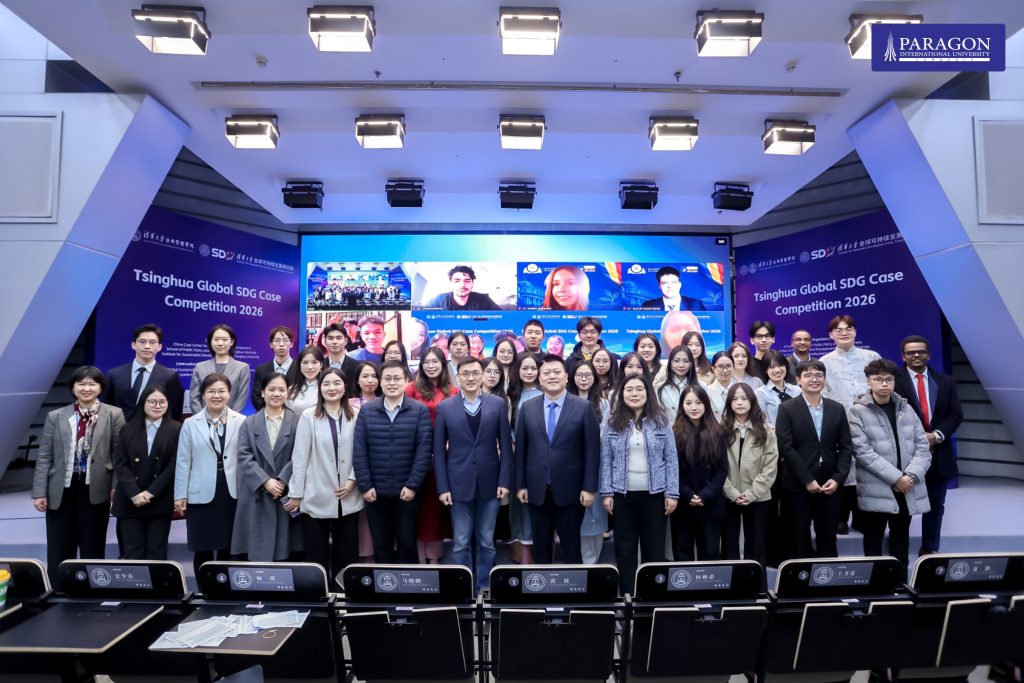
Achieving 10th place among 325 teams and receiving the Excellent Award in an international competition involving 251 universities across 45 countries and regions represents a meaningful accomplishment for SafeChamnun and Cambodia’s research community.
This achievement demonstrates that Cambodian youth and researchers have the potential to bring local challenges to international attention, contribute to global policy discussions, and develop innovative approaches to complex societal problems.
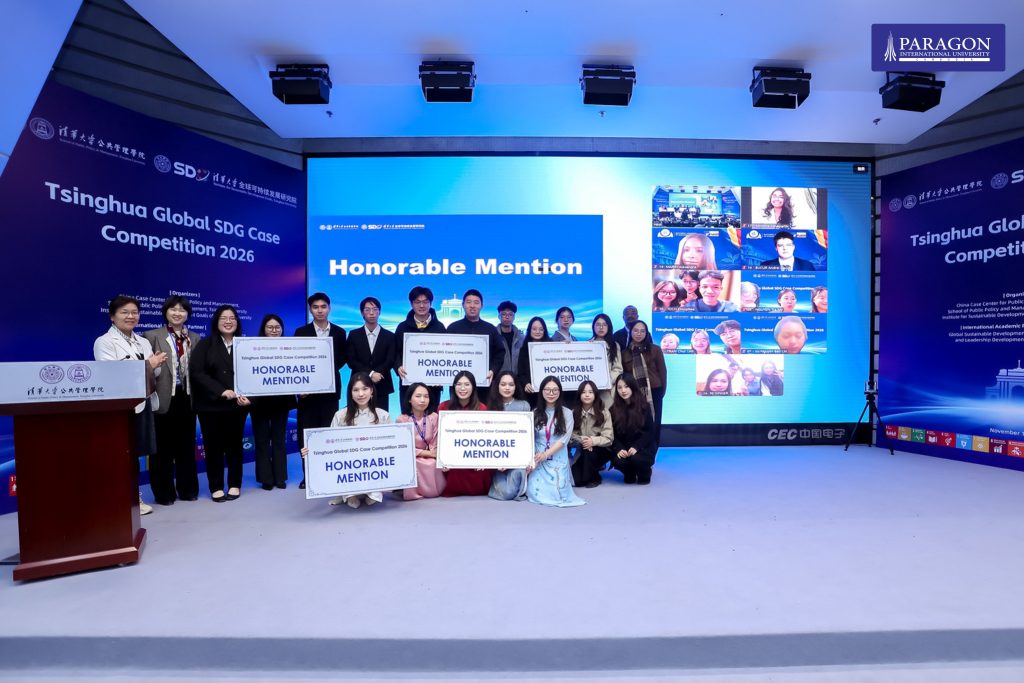
SafeChamnun’s success also reflects the importance of education, research, teamwork, and the determination of young Cambodians to apply their knowledge and technical expertise for the benefit of society.
Beyond receiving an international award, the team hopes its case study will encourage further discussions on responsible AI adoption, improvements to flood early warning systems, and stronger collaboration among researchers, government institutions, and development partners.
The achievement serves as an inspiration for young Cambodians to pursue research, embrace international opportunities, and contribute to solving challenges that extend beyond national borders.
From Cambodia to the world, SafeChamnun demonstrates that local challenges can inspire globally relevant research and that Cambodian youth have the knowledge, creativity, and determination to contribute to a safer, more resilient, and sustainable future.
About SafeChamnun
SafeChamnun is a Cambodian-led research initiative focused on the governance and responsible integration of artificial intelligence into flood forecasting and early warning systems in the Lower Mekong Basin.
Its research examines forecast validation, human oversight, institutional accountability, responsible data governance, and equitable access to early warning information.
Through its public policy case study, SafeChamnun aims to contribute to discussions on climate resilience, disaster risk reduction, and the responsible use of emerging technologies in Cambodia and the wider Mekong region.
About Tsinghua Global SDG Case Competition 2026
The Tsinghua Global SDG Case Competition 2026 is an international case study competition focused on analyzing real-world challenges and developing solutions aligned with the United Nations Sustainable Development Goals.
The 2026 competition began in June and attracted 325 teams from 251 universities across 45 countries and regions.
The final round took place on November 1, 2026, at Tsinghua University in Beijing, China.
Cambodia’s SafeChamnun team achieved 10th place and received the Excellent Award for its public policy case study on governing AI-driven flood early warning systems in the Lower Mekong Basin.