

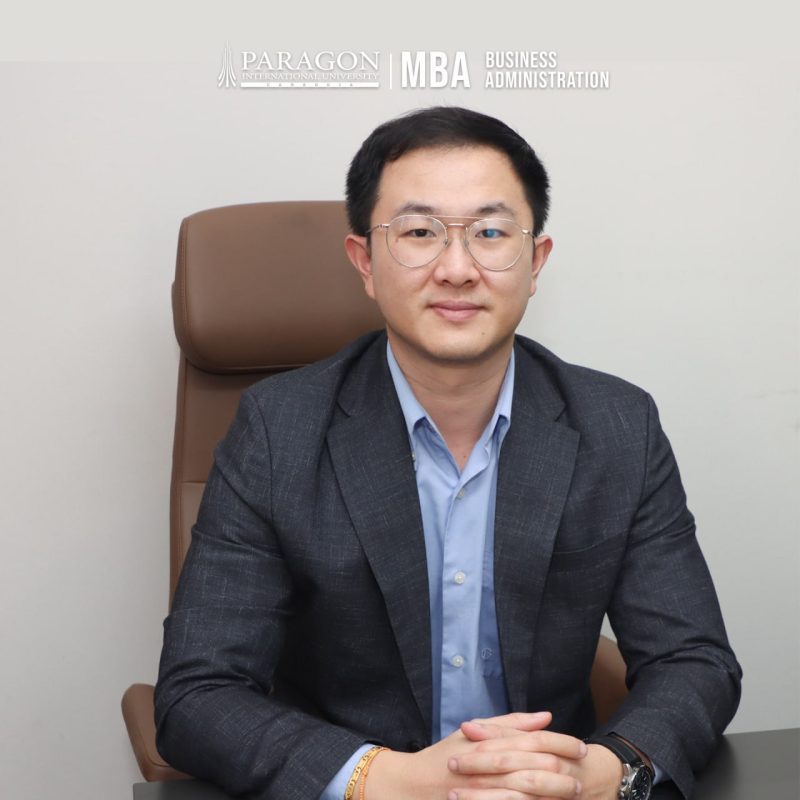
At Paragon International University, the MBA program continuously evolves to reflect the rapid transformation of global business environments. In line with the vision of the MBA program led by Julien Lussiez, MBA & DBA Program Director at Paragon International University, the curriculum continues to evolve to address the growing importance of digital finance and emerging technologies. As digital finance, artificial intelligence, and blockchain reshape economic systems and corporate strategy, our curriculum integrates these emerging technologies to prepare future leaders.
One of the newest additions to the MBA program is the elective course Digital Finance and Emerging Technologies (BUS 616).
To better understand the vision behind this course, we spoke with its instructor.
Meet Dr. Jonathan Seang
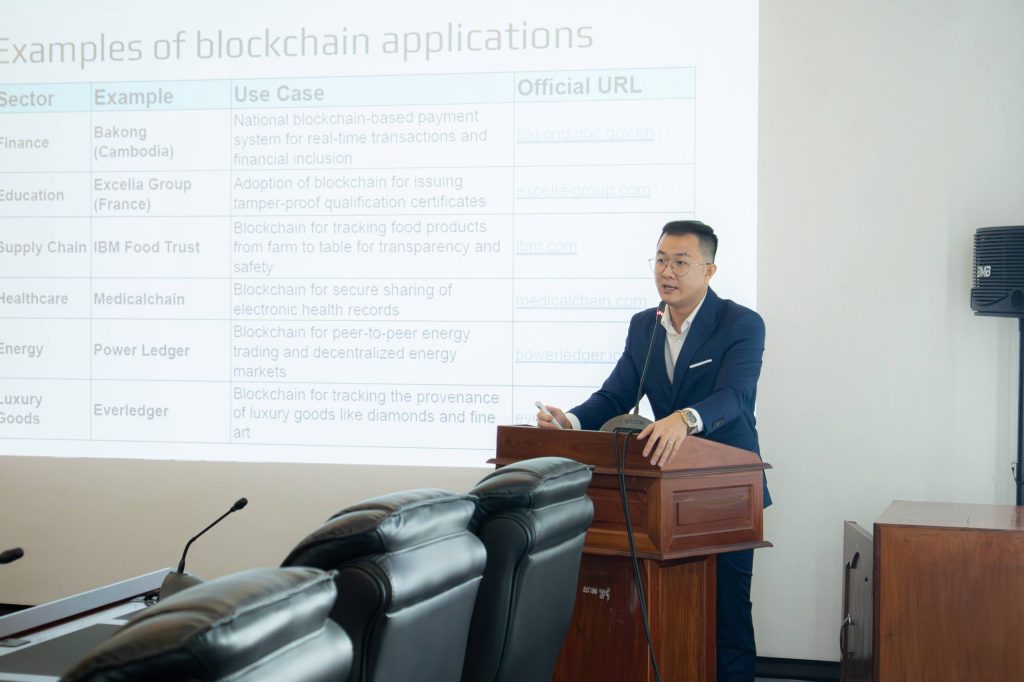
Dr. Jonathan is a lecturer in the MBA Program specializing in financial analysis, digital finance, and applied economics.
He completed both his Master’s degree and Ph.D. in Economics in France and has taught in higher education institutions in both France and Cambodia. His international academic background enables him to bridge rigorous economic theory with real-world corporate practice.
Alongside his academic role, Dr. Jonathan holds a senior management position at Soma Group, one of Cambodia’s leading conglomerates, where he contributes to strategic growth and financial performance.
Interview with Dr. Jonathan Seang
1. Why is it important for an MBA program to integrate digital finance and emerging technologies today?
Digital finance and emerging technologies are reshaping global business, so MBA programs must integrate them to prepare leaders for AI-driven strategies, blockchain innovations, and FinTech disruptions that traditional curricula overlook.
2. How does this course differentiate itself from traditional finance or economics courses?
This course stands out by focusing on practical FinTech ecosystems, blockchain applications, and data analytics tools. I even show students real demos such as creating DeFi wallets and using Dune Analytics, unlike traditional finance courses that rely on classical models.
3. Your background combines academic research in France and corporate leadership in Cambodia. How does this dual experience shape your teaching approach?
My PhD training in France gave me a strong foundation in rigorous economic theory, during which I taught over 400 students. Through consulting work in both France and Cambodia, and my current role at Soma Group, I have been able to bridge that academic grounding with real corporate experience. Together, these allow me to teach globally relevant economics that is specifically tailored to the realities of emerging markets.
4. The course includes FinTech ecosystems, blockchain, AI, and data analytics. Which of these areas do you believe will have the strongest impact on Cambodia’s economic development?
FinTech ecosystems will have the strongest impact on Cambodia’s economy, as they integrate payments, lending, and remittances into accessible platforms that drive SME growth, boost remittances from the diaspora, and enable rapid scaling of digital services in underserved rural areas, fostering inclusive development.
5. The course includes a real-world innovation project. Why is project-based learning important at the MBA level?
Project-based learning is vital at the MBA level because it turns theory into actionable skills through real-world innovation projects, especially in FinTech where things move fast and students can explore freely, simulating corporate challenges and building execution expertise.
6. You’ve also led the design and development of a digital asset exchange platform from scratch – what key learnings do you bring to BUS 616?
I share hands-on insights from orchestrating every stakeholder, for example: platform developers for scalable architecture, KYC/AML providers for compliance, wallet infrastructure partners for secure custody, SERC for regulatory alignment, OTP providers for user authentication, and price feed providers for real-time market data – equipping students to navigate these interconnected pieces from ideation to compliant launch.
7. How does digital finance contribute to financial inclusion and sustainable growth in emerging markets?
Digital finance advances financial inclusion in emerging markets by delivering mobile banking and examples like AI-powered credit scoring for the unbanked, such as apps using alternative data for microloans, while enabling sustainable growth via cost-efficient, data-optimised systems.
8. What skills will students develop by the end of this course?
Students will learn to analyse how FinTech, blockchain, and data-driven innovation transform business models, financial systems, and policy frameworks; design and evaluate strategic applications of digital technologies that enhance organisational efficiency, transparency, and inclusion; and critically assess the ethical, regulatory, and developmental implications of integrating emerging technologies such as AI into financial and economic systems.
9. In your opinion, what mindset should MBA students adopt to succeed in a technology-driven economy?
Adopt a mindset of lifelong learning and bold adaptability. Stay curious, research-driven, and open to trying new approaches. In a technology-driven economy, the ability to pivot quickly and embrace innovation is just as important as technical knowledge.
10. What advice would you give to professionals considering joining the MBA program at Paragon International University?
Join Paragon’s MBA for its cutting-edge BUS 616 course blending academic rigour with real industry insights. The program is well-suited for both early-career professionals and those looking to deepen their existing expertise, especially those eyeing leadership in Cambodia’s technology-driven economy.
Conclusion
The introduction of Digital Finance and Emerging Technologies reflects Paragon International University’s commitment to maintaining a forward-looking MBA program aligned with global trends and national development priorities.
By combining academic excellence with industry expertise, the MBA program prepares leaders capable of navigating digital transformation and driving innovation across sectors.
Join our Telegram community to stay updated on MBA courses, events, and admissions information: https://t.me/+PXLvhItSJNU2SWU1